
The Short Answer
A shingle roof lasts as long as its installation allows, which is why nail placement, flashing detail and ventilation matter more than the brand printed on the bundle. Shingles are fastened in a narrow nailing zone, sealed to each other by heat, and depend on the metal and underlayment beneath them at every edge and penetration. John Beal Roofing has been family-run since 1947, is Owens Corning Platinum Preferred and BBB A+ rated, and installs with in-house crews rather than subcontracted labor. A live person answers (317) 726-6000 around the clock, and the inspection behind your written estimate is free.
Why Installation Decides the Lifespan, Not the Label
Shingle manufacturers publish long warranty periods, and homeowners reasonably read those numbers as a promise about how long the roof will stay on the house. In practice the shingle itself is rarely what fails first. Asphalt shingle is a mature, well-understood product, and two bundles of the same architectural shingle installed by two different crews can differ in service life by a decade or more.
The reason is that a shingle roof is a system of overlaps. Each course covers the fasteners of the course below it, each valley depends on the metal or membrane underneath, and each pipe, chimney and wall junction depends on flashing that was cut, bent and layered in the correct order. Get the order wrong and water finds the fastener heads. Nothing about the shingle changes; the assembly around it stopped working.
That is the part of a roof a homeowner cannot inspect from the driveway once the job is done, and it is the part we scope in writing before the first bundle goes up. Our estimates name the tear-off depth, the underlayment and ice barrier going down, the flashing being replaced versus reused, the ventilation plan, and the price per sheet if decking has to come out.
What Goes Wrong Most Often on Indianapolis Shingle Jobs
High nails are the most common defect we find when we tear off a roof that is younger than it should be. Every architectural shingle has a reinforced nailing strip, and a fastener driven above it holds nothing but the top edge of the shingle while leaving the head exposed under the course above. The roof looks perfect on installation day and starts shedding shingles in the first serious spring wind line.
Overdriven and underdriven nails cause the same problem from the other direction. A gun set too hot punches the head through the mat, which turns a fastener into a hole; set too light and the head stands proud, dimpling and eventually cutting the shingle laid over it. Correct gun pressure is checked and re-checked as the day warms and the compressor behaves differently, which is a habit rather than a rule you can print on a bundle.
The third recurring failure is reused flashing. Step flashing along a wall, counter flashing at a chimney, and the collar on a plumbing vent are cheap relative to the roof and are the exact places water is aimed. Bedding new shingles against tired, previously-bent metal to save a small line item is how a brand-new roof produces its first leak in a year, and it is why we quote the metal as part of the installation rather than as an optional extra.
Three-Tab, Architectural and Designer Shingles
Three-tab shingle is the flat, single-layer product that covered most of the postwar housing stock across Marion and Johnson counties. It is the lightest and least expensive asphalt option, it lies very flat, and it is still a legitimate choice on a rental, a detached garage or an outbuilding where budget is the deciding factor. Its weakness is wind and its appearance is plainly dated next to anything newer on the block.
Architectural, sometimes called dimensional or laminate, is what the large majority of Indianapolis homeowners install today. Two mat layers are bonded together to create shadow lines and a thicker profile, which reads as depth from the street and gives the shingle noticeably more resistance to wind uplift than a three-tab of the same generation. As an Owens Corning Platinum Preferred contractor we install their architectural lines routinely and can show you full boards rather than a two-inch color chip.
Designer or premium shingle is heavier still, shaped to imitate slate or hand-split shake, and belongs on homes whose architecture supports it — the older brick and stone streets in Zionsville, Carmel and Meridian-Kessler are where it earns its cost. It is a real upgrade in appearance and mass, not a maintenance-free product, and we will say plainly when a roof line is too simple to show it off.
Everything Under the Shingle
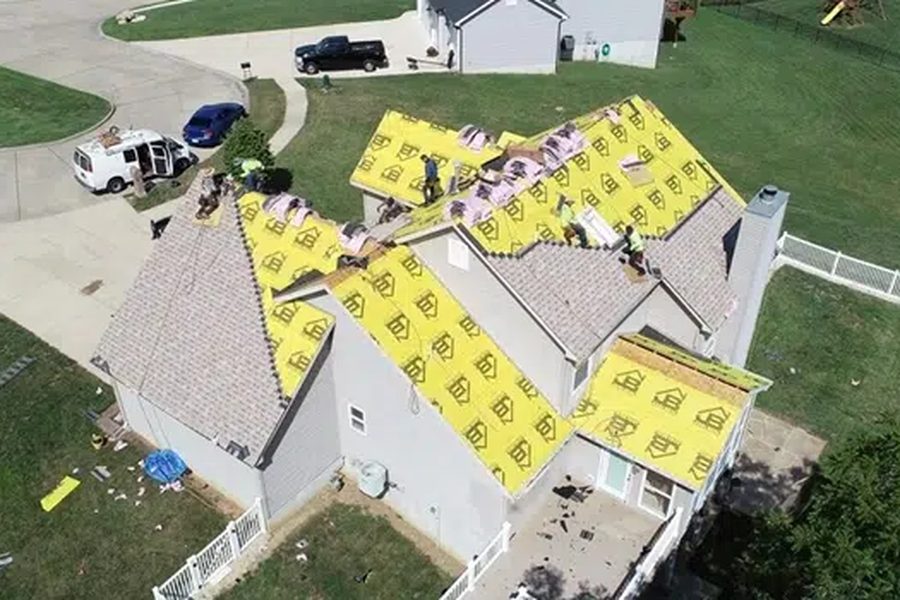
Tear-off comes first, and it goes to the deck. Layering new shingle over old hides the sheathing, adds weight, telegraphs every old irregularity through the new surface, and makes the next roof more expensive to remove. When we open a roof we can see soft plywood, delaminated sheets, rusted valley metal and rot along a fascia line — none of which is visible with a layer of shingle sitting on top of it.
Decking that will not hold a fastener gets replaced rather than covered, at the per-sheet price already stated in your estimate so the number does not move on you mid-job. Then underlayment goes down over the full field, with self-adhering ice and water barrier at the eaves and in the valleys where central Indiana's freeze-thaw cycle and winter ice damming push water uphill against the laps.
Starter course, drip edge, valley detail and new pipe collars follow, and only then does the field shingle begin. Ridge and hip caps close it out. Every one of those layers is ordinary, none of it shows in a photograph of a finished roof, and collectively it is most of what you are actually buying when you buy a shingle roof.
Ventilation Is Part of the Install
A shingle roof breathes or it cooks. Intake at the soffit and exhaust at the ridge move air under the deck continuously, which keeps summer attic temperatures down and, more importantly for Indiana, keeps the underside of the sheathing cold enough in winter that household moisture does not condense on it. A new roof installed over blocked soffits and a sealed ridge will age faster than the same shingle installed over a working system.
We look at the existing intake before we plan the exhaust, because adding ridge vent to a house with insulation stuffed into the soffit bays produces a system that pulls its air from the house instead of from outside. Balance is the whole point; more vents is not automatically better ventilation. Our attic ventilation guide works through how the two halves have to match.
Ventilation also settles arguments about condensation that homeowners understandably mistake for roof leaks. A stain that appears after a hard cold snap rather than after rain is usually attic moisture, and replacing the shingle above it will not stop it. Sorting that out during installation is far cheaper than discovering it afterward.
What Installation Week Looks Like
Most single-family shingle roofs in the Indianapolis metro are a one-day tear-off and install with a crew of eight to ten, occasionally two days when the roof is large, steep, cut up with dormers and valleys, or when weather closes the window. You will hear it — there is no quiet way to strip a roof — and the driveway will hold a dump trailer and a materials load for the duration.
Practical preparation matters more than people expect. Move vehicles clear of the drop zone, take framed pictures off shared walls because the vibration travels, and plan for dogs and small children to be somewhere else for the day. We tarp landscaping and run magnets across the lawn, driveway and street at the end of the job, and again the following morning, because a missed nail in a tire is a memorable way to ruin an otherwise good roof.
Then we walk it with you. You get photographs of the deck while it was open, of the flashing and ice barrier before the shingles covered them, and of the finished surface, plus the written workmanship warranty on qualifying work. If you are still deciding between repairing and replacing, start with a free roof inspection or read the signs you need a new roof first.
Frequently Asked Questions
How long does a new shingle roof take to install?
Most Indianapolis-area homes are stripped and reshingled in a single day by a crew of eight to ten. Large, steep or heavily cut-up roofs run into a second day, and weather can extend that. We give you the expected schedule in writing before the job is booked.
Can you install new shingles over my existing roof?
We do not. A layover hides the decking, adds dead load, mirrors the old surface irregularities and makes the next tear-off more expensive. Full tear-off to the deck is how we install shingle roofs, because it is the only way to see and correct what is underneath.
Are architectural shingles worth more than three-tab?
For most homeowners, yes. Architectural shingle is two bonded mat layers instead of one, which gives it a thicker profile, real shadow lines and better resistance to wind uplift. Three-tab remains a sensible choice on garages, outbuildings and budget-driven rental property.
What happens if you find rotten decking after the tear-off?
We replace it. Your estimate carries a per-sheet price for decking before work starts, so the cost of a bad sheet is known rather than negotiated on the roof. Sheathing that cannot hold a fastener is never covered over, because shingles nailed into soft plywood lift in the next windstorm.
Do you install Owens Corning shingles?
Yes. John Beal Roofing is an Owens Corning Platinum Preferred contractor and installs their shingle lines routinely. We bring full sample boards to the estimate rather than color chips, because a two-inch square tells you very little about how a roof will read from the street.
Is the estimate for a new shingle roof free?
Yes. The inspection, the measurements and the written estimate cost nothing and come with no obligation, and the photographs we take are yours to keep. A live person answers (317) 726-6000 at any hour, including nights and weekends.
Shingle Roof Installation Across the Indianapolis Metro
We install shingle roofs throughout the ten counties we cover — including Carmel, Fishers, Noblesville, Zionsville, Greenwood, Plainfield and Brownsburg. For the full project scope see roof replacement, compare the alternative in metal roofing, or read what a repair costs if replacement is not yet warranted. See every city and town we cover →
Get a free roof inspection
No charge, no obligation, and you keep the photographs. A live person answers 24 hours a day.